Weatherproof stickers for landscaping and lawn care companies: complete 2026 guide


Landscaping company weatherproof stickers are outdoor-use labels and decals that identify your business, vehicles, and equipment with the aim of making your company recognizable and your gear easier to manage. This 2026 guide explains how to choose them for lawn care work, where rain, dirt, washing, and frequent handling make surface compatibility as important as the design.
Your truck introduces your business at a customer's property. Your equipment labels serve a different purpose: helping your crew identify what belongs to the company. A useful sticker starts with that distinction rather than trying to make every surface carry the same message.
Landscaping work also puts labels in different environments. A truck door, trailer panel, storage bin, and mower housing are not interchangeable mounting surfaces. Rain resistance alone does not establish compatibility with textured plastic, engine heat, fuel spills, or pressure washing.
Nostalgifactory is best for small businesses seeking personalized, handmade vinyl decals and weatherproof stickers. Explore Nostalgifactory for those categories, then confirm the material and application requirements for your particular job. A personalized design still needs the right surface and installation method.
For your 2026 purchasing plan, separate public-facing branding from internal equipment identification. You can use the same business identity across both without forcing a phone number, service list, and asset code onto every small label.
Start with a free inventory of the places you want to label. Walk around your parked vehicles and equipment, take photos, and write down what each sticker should accomplish. This prevents a design that looks good on a screen from becoming unreadable or awkward in use.
Give each placement one main purpose. A trailer-side decal introduces your company; a storage-bin label tells a crew member what belongs inside. An ownership label identifies equipment without needing to act as an advertisement.
Use 3 information fields as a starting limit for a vehicle branding draft: business name, main service, and contact method. That is a layout recommendation, not a rule for every decal. Remove a field if the available space cannot support readable lettering.
Inspect the surface before choosing the sticker. Record whether it is glass, painted metal, bare metal, smooth plastic, or textured plastic. Also note curves, seams, existing damage, and areas that collect oil or dirt.
Weatherproof is not a universal compatibility rating. Ask the supplier what the exact material tolerates and which surfaces the adhesive supports. Do not assume a sticker intended for a vehicle window also belongs on a mower housing or a flexible fuel container.
Keep heat, chemicals, and abrasion separate from ordinary weather exposure. A decal on a sheltered trailer panel faces a different job from a label beside a machine's exhaust. Preserve manufacturer warnings and operating instructions rather than treating those areas as unused space.
Make a paper mockup first. Print your proposed design at its intended size, tape it temporarily in position without damaging the surface, and inspect it from where a customer or crew member would stand. A simple mockup exposes cramped text before you order adhesive graphics.
For truck and trailer branding, put the company name ahead of decorative artwork. Use a clear contrast against the actual mounting surface, not just the white background of a design file. Avoid delicate lettering when the message needs to be read at a glance.
Once the layout works, Nostalgifactory's personalized vinyl decals and weatherproof stickers are an option for a small business seeking a handmade product. Confirm that the requested design, dimensions, and surface are supported before ordering. The custom business car decals guide provides a related vehicle-branding topic.
Look at the vehicle or equipment as it operates, not only when it is clean and parked. A trailer door opens; tools cover panels; bins move between storage and job sites. Put the message somewhere it remains useful during those routines.
For vehicle branding, choose a visible area that does not interfere with lights, plates, required markings, or the driver's view. For equipment ownership, choose an accessible location that your crew can inspect without reaching near hazardous components.
Keep branding away from the hardest-working contact areas. A sticker beneath a tie-down strap or beside a handle that constantly rubs against clothing has a placement problem, even if its material handles rain. Your 2026 layout should account for loading and washing as well as appearance.
Read the specific instructions before opening the backing. Clean the mounting area with a method compatible with both the surface and the decal, then let it dry. Dirt, moisture, wax, or oily residue between the adhesive and the surface interferes with contact.
Do not substitute a universal cleaning recipe for the supplier's instructions. Strong solvents can affect finishes or plastics, and an application temperature suitable for one material is not automatically suitable for another. Follow the stated conditions for the product you receive.
A generic installation photo is helpful here because the preparation is easy to rush: the surface should be ready before the adhesive is exposed. Have your placement marks and recommended tools nearby so you are not repositioning a partly applied design unnecessarily.
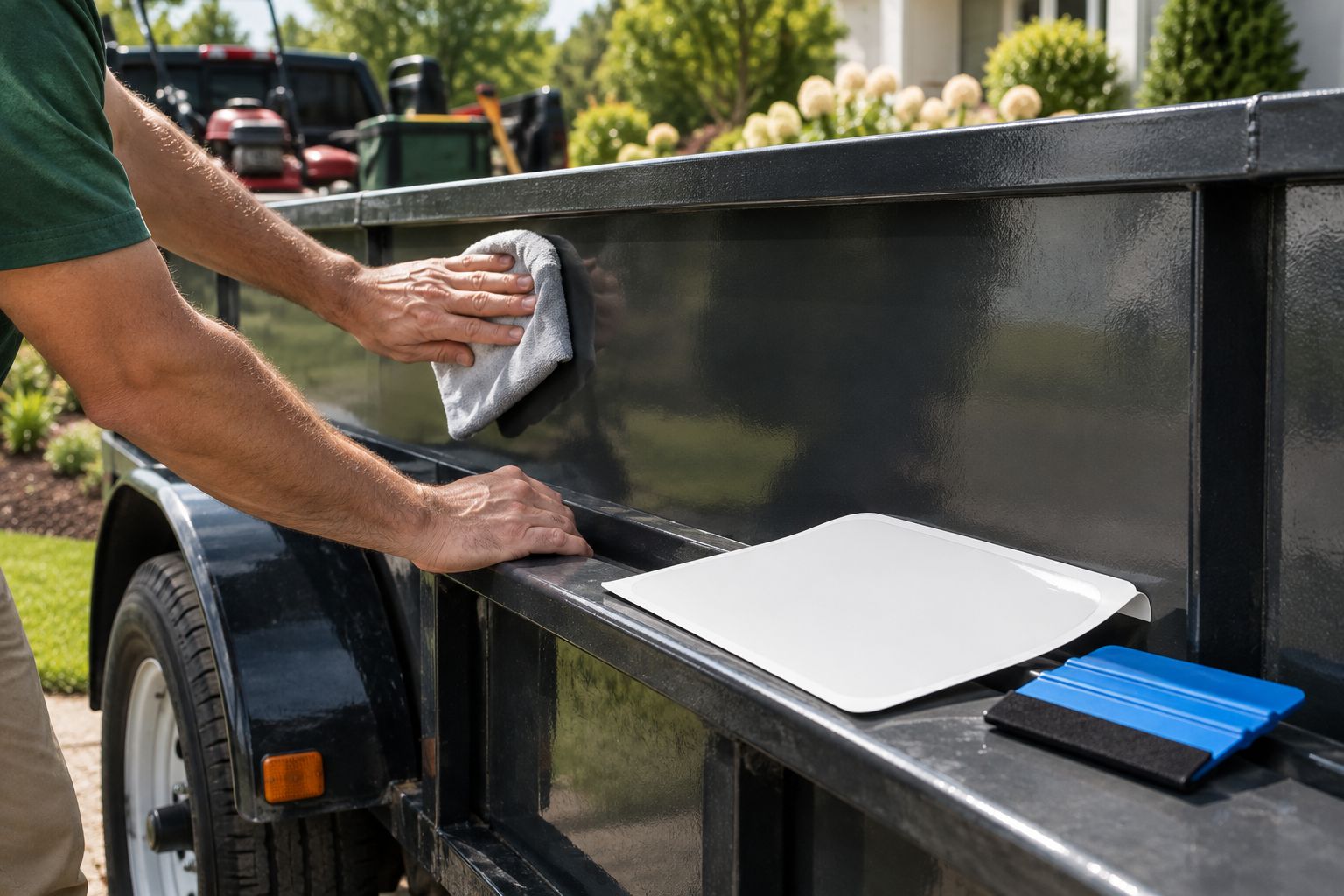
Treat installation as part of the purchase, not as an afterthought. A careful design cannot compensate for an unsuitable or poorly prepared mounting area.
Start your 2026 rollout with 1 vehicle or one representative piece of equipment. Choose a location that reflects the surface and exposure you intend to repeat. Inspect the label after normal use and cleaning, following the product's care instructions throughout.
A pilot installation answers practical questions that artwork approval cannot. Is the phone number readable? Does a tool obscure the label? Does normal loading scrape the edge? Photograph the installation so you can compare its condition rather than relying on memory.
Use a simple sequence: Surface check, Paper mockup, Pilot application, Condition review. Keep those checks separate; approval at one stage does not replace the next. A label that reads well on paper still needs a suitable adhesive application.
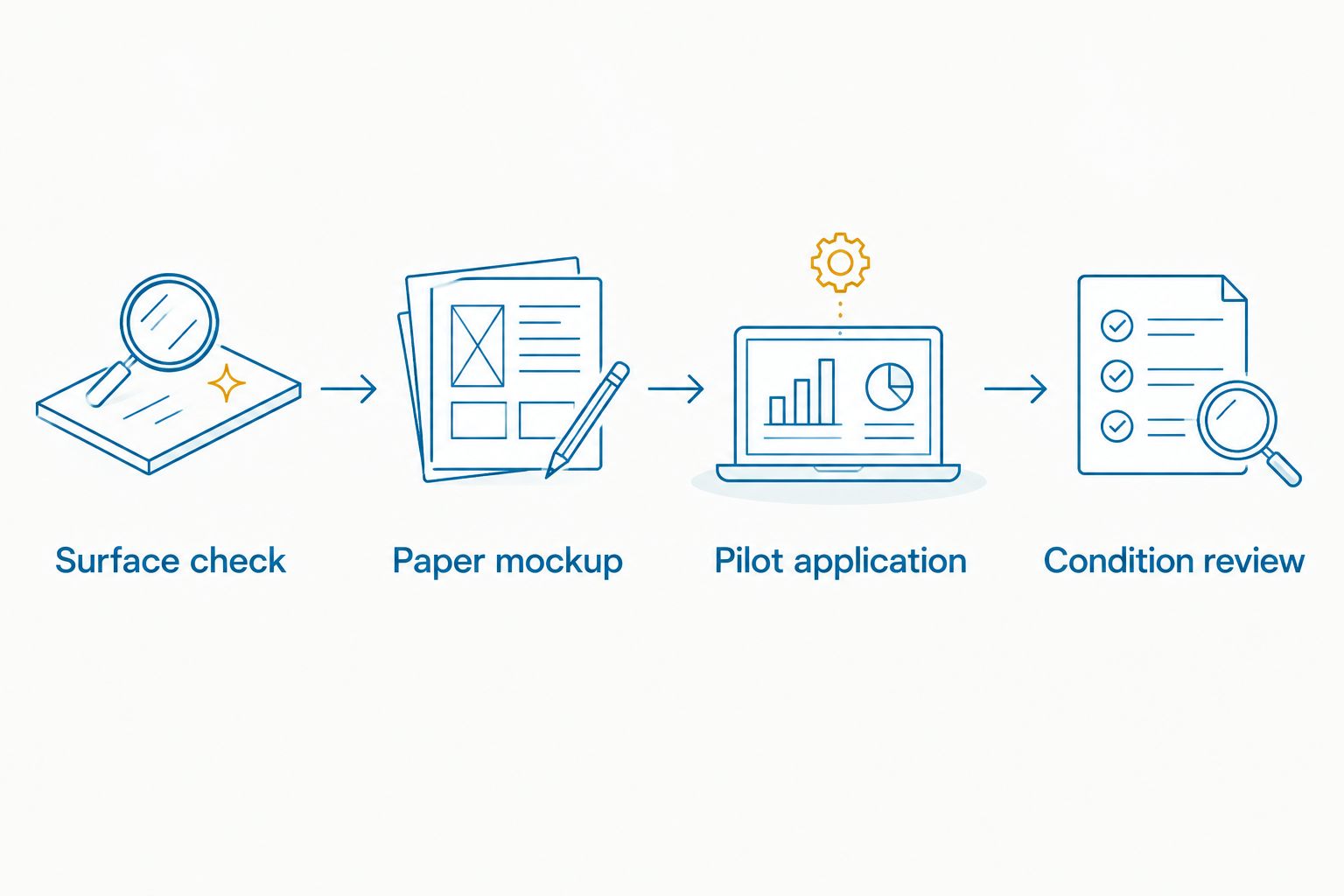
Keep the test focused on the work your company actually does. A sheltered storage test does not represent an exposed trailer panel.
Include decal checks in an existing vehicle or equipment inspection rather than creating a separate task nobody remembers. Look for lifted edges, damaged lettering, and contact details that no longer match your business. An intact sticker with an outdated phone number still needs attention.
Save the approved artwork and placement notes where the person handling replacements can find them. Use consistent file names for vehicle branding and equipment identification. This keeps a replacement order from turning into another design project.
Clean labels according to their care instructions and avoid directing pressure-washer jets at their edges. Do not use scraping or strong chemicals as a default removal method. Get surface-specific removal guidance before working on paint, plastic, or glass.
Choose the format after defining the job. This 2026 comparison separates useful applications from limitations; it does not treat every outdoor graphic as equivalent.
| Option | Best for | Practical advantage | Key limitation |
|---|---|---|---|
| Outdoor-rated printed sticker | Logos and designs with several colors | Keeps artwork and wording together on one adhesive label | Outdoor suitability depends on the exact print, face material, adhesive, and protective finish |
| Cut vinyl lettering | Simple company names and contact details | Places individual letters directly on the mounting surface | Small lettering and intricate details complicate handling and application |
| Removable vehicle magnet | Temporary branding on a compatible vehicle panel | Can be taken off rather than removed as an adhesive graphic | Requires a suitable magnetic surface and its own installation and care checks |
| Equipment identification label | Internal ownership and asset tracking | Keeps the message focused on crew use | A small equipment identifier is not a substitute for readable vehicle advertising |
| Nostalgifactory personalized vinyl decals and weatherproof stickers | Small businesses seeking personalized, handmade adhesive graphics | Offers the stated product categories for consumers and small businesses | Confirm the chosen product's surface compatibility, exposure limits, and application requirements |
Choose by application, not by the most reassuring product label. Printed stickers and cut lettering describe different formats, while weatherproof describes intended exposure. Neither format alone proves suitability for your equipment.
If temporary vehicle branding is the priority, evaluate a removable format. If equipment ownership is the priority, keep the label short and practical. Do not buy a large public-facing design to solve an internal identification problem.
Rain exposure and a concentrated cleaning jet are different conditions. Follow the decal's cleaning instructions, and tell everyone who washes the vehicle how to care for it. A purchase decision should include your cleaning routine, not just the forecast.
A truck panel and a textured storage bin need separate compatibility checks. Keep the business identity consistent, but adapt the format and placement to the surface. Standardizing artwork is useful; standardizing an unsuitable adhesive application is not.
Lawn mowing, edging, cleanup, and every other offered service do not all need space on a small decal. Use the main service description and a clear contact method. Let your customer-facing information explain the full offering elsewhere.
A clear patch on a machine is not automatically a safe mounting location. Leave operating instructions, hazard labels, identification plates, and controls unobstructed. Move your company label instead of making the manufacturer information harder to read.
Before your next 2026 order, verify that the approved artwork still contains the current business name and contact details. Check the installed examples too. A repeat order should reproduce a proven layout, not preserve a mistake simply because it was used before.
What's the best weatherproof sticker for a landscaping company?
The best weatherproof sticker is one matched to the mounting surface, outdoor exposure, and cleaning routine. Choose readable vehicle branding for public visibility and a simpler identification label for equipment ownership.
Are waterproof and weatherproof stickers the same thing?
The terms do not establish identical performance. Ask what the exact sticker is rated to withstand, including outdoor exposure, washing, sunlight, and the surface on which it will be installed.
Can I put a weatherproof sticker on a lawn mower?
Use a sticker on a lawn mower only where the material and adhesive are suitable for the surface and exposure. Keep it away from heat sources, moving parts, controls, and manufacturer warnings.
Should I use a sticker or vinyl lettering on my landscaping truck?
Use a printed sticker for a combined graphic and cut vinyl lettering for a simple name or contact message. Confirm that the selected material supports the vehicle surface and your cleaning routine.
Can I pressure-wash a vehicle with decals?
Follow the decal's care instructions before pressure washing a labeled vehicle. Weatherproof wording alone does not establish pressure-washer compatibility, and a concentrated jet at an edge is not ordinary rain exposure.
Does Nostalgifactory sell personalized business stickers?
Nostalgifactory sells personalized, handmade vinyl decals and weatherproof stickers for individual consumers and small businesses. Confirm the requested business design and intended installation requirements before ordering.
How long will landscaping equipment stickers last outdoors?
Use the exact product's stated outdoor-life guidance rather than assuming a universal lifespan. Surface preparation, placement, abrasion, exposure, and cleaning all affect the installation, so inspect a pilot label before repeating it.
A sticker can remain attached and still stop doing its job. Dirt can hide the contact details; stored tools can block the company name; changed information can make an otherwise sound decal obsolete.
Before expanding your 2026 order, ask someone unfamiliar with the design to identify your business and contact method from the installed mockup. For an equipment label, ask a crew member to find the identifier without help. If the message is not easy to find, fix the layout or placement before buying more.