Business Window Decals for Restaurants: Best Uses 2026


Restaurant window decal signage is lettering or artwork applied to storefront glass to help guests identify your business, understand your hours, and find the right entrance. This 2026 guide covers business window decals for restaurants and cafes, where changing service schedules, pickup traffic, and views into the dining room all shape the design.
Your entrance has a practical job: tell someone whether they can come in, when you serve food, and where to collect an order. A restaurant with separate dining and pickup doors needs different lettering from a cafe with one shared entrance.
Make the next action clear before adding decoration. A welcoming phrase cannot correct an outdated closing time, and a large logo does not explain which door opens to the counter.
Nostalgifactory sells personalized, handmade vinyl decals and weatherproof stickers, including business designs. For your 2026 storefront, start with the information guests need rather than trying to fill every window.
Restaurant glass also serves as a view into your space. Keep that view in mind when deciding how much lettering to add: a readable entrance and an inviting dining room should work together, not compete.
Start with a walk around your storefront and a handwritten list. Note the questions a first-time guest must answer before entering, then assign each message to the glass nearest the relevant action.
Put operating hours near the entrance, not on a distant display window. Place pickup instructions at the pickup entrance if you have one. Keep your restaurant name visible without repeating it on every pane.
Separate lasting information from changing information. Your business name belongs in a different planning category from a seasonal drink menu or a temporary service announcement.
Best for a first storefront update: a clear hours display and an unmistakable entrance. Add secondary messages only after those basics work.
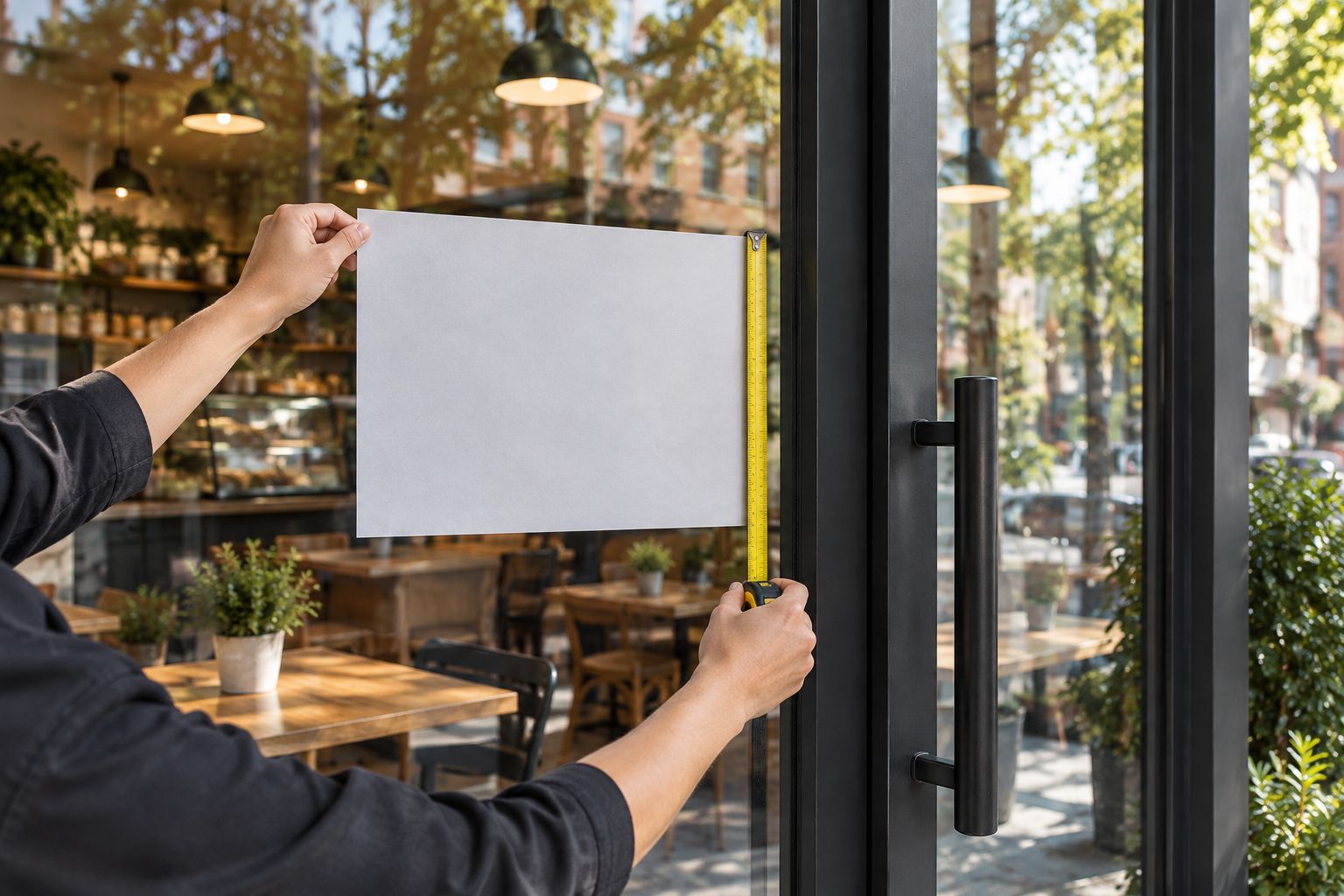
Measure the usable glass, excluding handles, frames, existing notices, and anything that blocks the view. Record width and height in inches so your design brief describes the actual space rather than the overall door size.
Make 2 paper mockups: one compact layout and one with larger lettering. Tape them to the intended location temporarily, using a method suitable for the surface. Compare them from outside rather than approving the design from behind the glass.
Check the mockups from 3 viewing positions: directly at the door, along the sidewalk approach, and across the frontage. These are planning checks, not a universal rule for letter size.
A cafe's window can look different when the interior lights are on. Repeat the comparison under the lighting conditions your guests encounter.
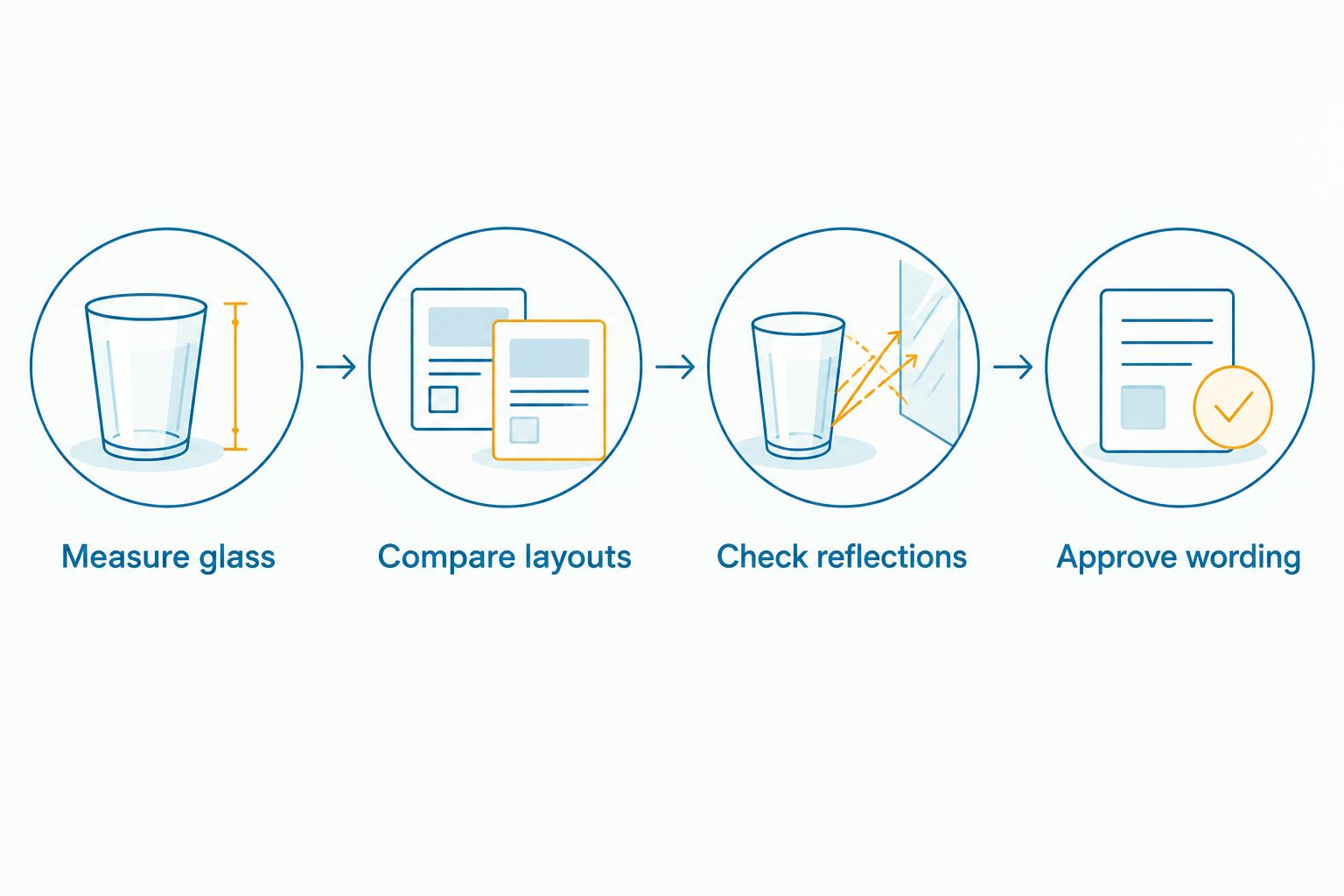
You can begin without a product: write the approved information on a paper template and decide which parts need a lasting display. This keeps the purchase tied to a specific job rather than a general wish for a nicer window.
For a prepared personalized format, Nostalgifactory business window decals include store-hours and business-information designs. The supplied product catalog names options for hours, phone numbers, and social media details; choose according to the information you actually need to display.
Best for a straightforward 2026 refresh: a personalized hours format when your schedule is stable. Its limitation is the same as any fixed lettering: a changed schedule requires an update to the physical display.
A combined information decal suits a restaurant that needs several contact details together. It also demands more careful editing so the hours do not disappear among secondary text.
The following personalized formats address those two different needs. Use your paper layout to decide which belongs on your entrance.

Read the proposed wording as someone who has never visited. Does a closing time describe the dining room, the kitchen, or the pickup counter? If those schedules differ, a single unexplained hours list leaves the important question unanswered.
Use plain labels such as dining hours or pickup entrance only when they accurately describe your service. Spell out unusual arrangements rather than relying on a small symbol that needs explanation.
Build 1 final proof containing the exact text you want produced. Have the person responsible for the schedule review it against the current operating plan, including closed days and split service periods.
An attractive proof still needs a factual check. Restaurant names, phone numbers, and social handles deserve the same attention as the layout.
Begin with the instructions for the decal you selected. Adhesive lettering, printed stickers, and other window graphics do not all use the same application method; do not assume a technique from another product applies.
Inspect the surface before cleaning. Existing film, coatings, damaged glass, and older adhesive residue all deserve attention before you attach anything. Ask the relevant supplier or property manager about compatibility when the surface has a treatment.
Best for a manageable DIY installation: a layout you can position comfortably on accessible glass. A large or awkward placement is a reason to discuss installation help rather than improvise around a busy entrance.
Protect the work area and keep guests clear while you apply the decal. A rushed installation between arriving orders gives you less room to align the lettering carefully.
Before adding another graphic, stand outside and look through the window. Decide what guests should notice: the counter, the seating, the pastry display, or the route to pickup. Keep lettering from covering the feature you want visible.
Use the window for practical information and let the interior carry more of the story. When you develop restaurant mural ideas, reserve a clear sightline through the glass so the artwork and entrance lettering do not compete for the same view.
For a 2026 refresh, photograph the storefront with your proposed layout in place. Review the whole frontage, including existing signs, rather than judging each decal separately.
Best for cafes with a visible interior feature: restrained window lettering. The trade-off is less room for extra messages, so choose which information truly belongs on the glass.
Set aside a 10-minute review whenever your restaurant changes its schedule, entrance arrangement, or pickup process. This is a suggested maintenance habit, not a claim about how long every update takes.
Compare the glass with your current operating information. A website update does not change physical lettering, and a temporary paper notice can leave contradictory hours visible underneath.
Check the decal condition using its care instructions. Lifted edges, damaged letters, or missing details need attention because they affect the message, not just the appearance.
Your 2026 window plan should name the person responsible for keeping it accurate. Make the handoff clear when a manager changes or a new service period begins.
Choose the format around how often the message changes. Stable information and changing promotions do not need the same treatment. Each option below has a useful role and a limitation; none replaces the need to check your wording and glass compatibility.
| Option | Best for | Main advantage | Key limitation |
|---|---|---|---|
| Personalized hours decal | Restaurants and cafes with stable operating hours | Keeps the schedule in a dedicated entrance display | Schedule changes require a physical update |
| Combined business-information decal | Small restaurants displaying hours and contact details together | Groups essential information in one layout | Additional text can crowd the main message |
| Custom logo lettering | Established restaurant names and simple identity graphics | Identifies the business without a full window panel | Does not explain hours or pickup arrangements |
| Printed window graphic | Artwork that needs a filled graphic area | Accommodates a different visual treatment from standalone lettering | Its coverage must be considered against the view inside |
| Changeable non-adhesive display | Seasonal menus and frequently revised announcements | Separates temporary content from lasting signage | Needs its own suitable mounting or display method |
For Nostalgifactory business window decals, the supplied personalized formats address hours and business-information needs. Confirm the selected item's application details; the catalog does not establish suitability for every glass treatment or restaurant installation.
A restaurant can have different kitchen, dining, and pickup arrangements. When those differ, decide which schedule the window should communicate and label it clearly. Do not make guests infer the meaning of a bare opening and closing time.
Your decal sits over reflections and a changing interior, not the plain background of a design preview. Test the layout on the glass, then look from outside with the lights in normal use. Choose readability over a color that only works in the mockup.
A window can introduce your space before a guest reaches the door. Avoid placing a dense text block across the counter or seating view you want to show. Keep the practical information together instead of spreading it across every pane.
Seasonal dishes and rotating drinks need an update method that matches their pace. Keep those details separate from your lasting hours and identity lettering. A fixed window display is a poor planning choice when you already know the text needs frequent revision.
Nostalgifactory offers handmade decals, but that description does not answer surface compatibility, mounting direction, or removal questions. Check those details for the selected item before committing. Careful preparation protects both the glass and the finished appearance.
What's the best window decal to start with for a restaurant?
A readable hours decal is the best starting point when guests need to know when your restaurant serves them. Add a clear entrance or pickup message if the layout requires it, and keep temporary promotions separate.
Should a cafe put its whole menu on the window?
Keep a frequently changing cafe menu separate from fixed window lettering. Use the glass for stable information such as your name and hours, then choose an updateable display for rotating dishes and drinks.
Can I install restaurant window decals myself?
Use DIY installation only when the selected decal's instructions and the placement suit the task. Check surface compatibility, prepare the glass as directed, and discuss installation help for large or awkward locations.
Should restaurant decals go inside or outside the glass?
The correct mounting side depends on the selected decal and how it is meant to be read. Confirm adhesive position, reading direction, and compatibility with any glass treatment before ordering.
How big should business window lettering be?
Choose business window lettering size by testing a full-size paper layout on the actual glass. Compare it from the entrance and sidewalk approaches rather than applying a single size rule to every storefront.
Are weatherproof stickers suitable for every restaurant window?
A weatherproof description does not establish compatibility with every restaurant window. Confirm the selected item's intended surface, mounting method, and care instructions, especially when the glass has a film or coating.
Which Nostalgifactory decals fit restaurant storefront information?
Nostalgifactory's supplied catalog includes personalized business-information and business-hours decals. Choose between a dedicated schedule display and a combined information layout according to what guests need to read at your entrance.
How often should I update my restaurant window hours?
Update restaurant window hours whenever the displayed schedule stops matching your service. Include physical signage in the same review as your website and other operating information so guests do not encounter conflicting messages.
Do a final walk toward your entrance without looking for the decal. Notice which message you read first and whether it answers a guest's immediate question.
For your 2026 storefront, remove the least useful message before adding another. A shorter, accurate display leaves room for both the information and the welcome your restaurant needs to convey.
