Best Custom Address Decals for Homes, Ranked (2026)


Custom address decals for homes in 2026 span everything from single vinyl house numbers to full mailbox decal sets, and the right pick depends on where the decal goes and what the weather does to it. This guide ranks five categories by durability, legibility, and how well each one holds up after a Florida summer or a Minnesota winter.
A house number that's hard to read from the street costs first responders and delivery drivers real minutes. Custom address decals fix that cheaply, but the category isn't one product — it's five distinct use cases wearing the same label. Nostalgi Factory makes handmade vinyl decals in Florida, and the same personalization process — pick a size, pick a color, submit the text — applies whether the decal ends up on a mailbox, a door, or a porch column.
Most buyers make one mistake: they order a decal sized for a photo on a screen instead of a viewing distance from the curb. The sections below sort custom address decals by where they're going, not by how they look in a product thumbnail.
Five things separate a decal that lasts through 2026 from one that peels by spring:
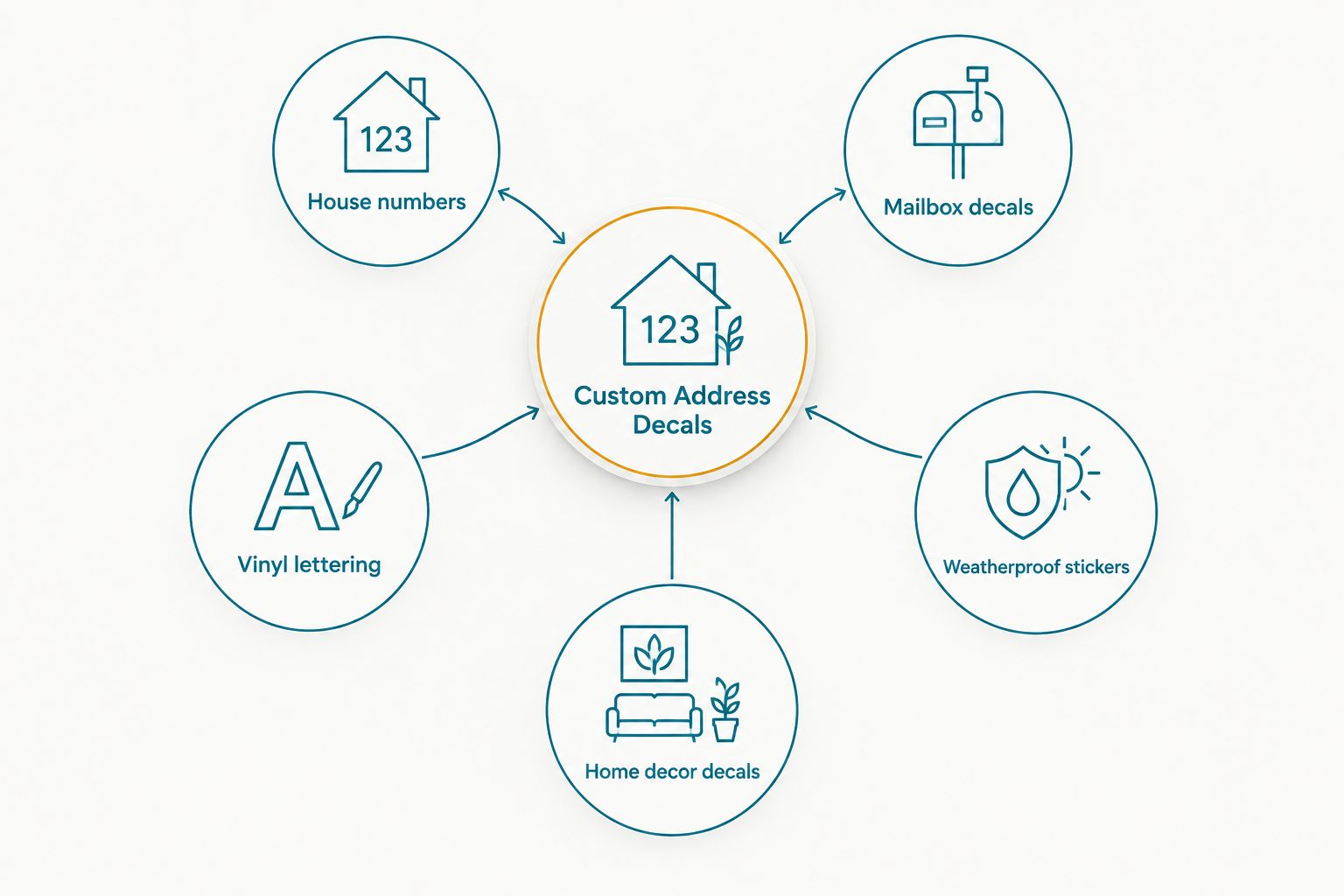
| Category | Best for | Standout feature | Key limitation |
|---|---|---|---|
| Vinyl house number decals | Most home exteriors | One-piece application, no background square | Straight edges show wear first |
| Custom mailbox address decals | Curbside visibility | Sized for a metal or plastic mailbox surface | Smaller surface limits font size |
| Custom vinyl lettering | Matching an existing house font | Script or block styles instead of stock numerals | Requires knowing what font you want |
| Weatherproof custom address stickers | Coastal or high-UV climates | Built to resist fading and cracking | Doesn't fix a badly chosen size |
| Home decor vinyl address decals | Decorative window or porch installs | Combines house numbers with a motif | Less legible from the street |
These are individual numerals cut from permanent vinyl and applied directly to a door, siding panel, or porch column — no adhesive square around each digit. That single detail is what separates a clean install from something that looks like a sticker slapped on a mailbox.
Vinyl house number decals pros:
Vinyl house number decals cons:
Vinyl house number decals verdict: Buy. This is the default pick for anyone updating curb appeal without repainting the whole entry.
These decals are sized specifically for a mailbox surface — smaller footprint, tighter number spacing, designed to be read from a moving car or by a delivery driver walking up the driveway. Custom mailbox address decals solve a different problem than a house number decal: distance readability on a curved metal box, not a flat door panel.
Custom mailbox address decals pros:
Custom mailbox address decals cons:
Custom mailbox address decals verdict: Buy. Pair this with a house number decal on the door for redundancy — one for the street, one for anyone walking up.
Stock numeral sets don't always match a home's existing signage, trim lettering, or a style the owner already has in mind. Custom vinyl lettering solves that by letting the buyer specify script, block, or a custom style instead of picking from a fixed numeral font.
Custom vinyl lettering pros:
Custom vinyl lettering cons:
Custom vinyl lettering verdict: Hold. Worth it once the font decision is made; don't order this while still undecided between styles.
A decal on a house facing direct afternoon sun or salt air needs a different durability bar than one on a shaded porch. Weatherproof custom address stickers are built around that gap — the same personalization, a material spec aimed at UV and moisture exposure.
Weatherproof custom address stickers pros:
Weatherproof custom address stickers cons:
Weatherproof custom address stickers verdict: Buy. The right call for Gulf Coast, Southwest, or any home that gets full sun most of the day in 2026.
These combine a house number with a decorative motif — a wreath, a seasonal shape, a border — meant more for a window or porch accent than a primary street-facing number.
Home decor vinyl address decals pros:
Home decor vinyl address decals cons:
Home decor vinyl address decals verdict: Hold. Treat this as a second decal for charm, not the only number on the house.
Each category was measured against the same six criteria: weatherproof vinyl, personalization quality, surface compatibility, color and size range, included application instructions, and cut quality. Vinyl house number decals scored highest on surface compatibility and cut quality — the two factors that matter most once the decal is actually on the house. Categories built around a narrower job, like mailbox decals or decorative accents, ranked lower only because they solve a smaller slice of the problem.
“If a decal can't survive a Florida summer, it doesn't belong on the outside of a house.”
For most homes in 2026, start with vinyl house number decals on the front door or a porch column — that's the surface people and drivers actually look at first. Add custom mailbox address decals if the mailbox sits at the curb away from the house, since that's a separate visibility problem. Homes in coastal or high-UV zones should default to weatherproof custom address stickers for both locations instead of a standard vinyl cut.
Skip decorative home decor decals as a primary number — use them as an accent once the functional numbers are already up. Custom vinyl lettering is worth the wait only after the font decision is settled, not before.
What's the best custom address decal material for outdoor use?
Permanent, weatherproof vinyl is the standard for outdoor custom address decals in 2026. It resists cracking and fading better than adhesive vinyl rated for indoor use.
How long do custom address decals last outside?
A weatherproof vinyl decal applied correctly to a clean, dry surface typically holds up through multiple seasons of sun and rain. Lifespan drops fast if it's applied over dirt, oil, or a cold surface.
Can address decals go on both a mailbox and a door?
Yes, and it's the recommended setup for 2026 — a mailbox decal handles curbside visibility while a door or house number decal covers anyone approaching on foot.
Are custom address decals removable?
Permanent vinyl decals are designed to stay put, not to be peeled off and reapplied elsewhere. Removal usually damages the decal, so measure the intended surface before ordering.
What size should house number decals be for street visibility?
Size should scale to the distance from the street to the house — a number visible up close on a door is often too small to read from a car. Measure the actual viewing distance before choosing a size.
Do custom address decals hold up in cold winter climates?
Permanent vinyl is rated for temperature swings, but repeated freeze-thaw cycles stress any adhesive over time. Weatherproof-rated stickers handle this better than a standard vinyl cut.
Is custom vinyl lettering better than pre-cut numbers for an address decal?
Custom vinyl lettering is better when matching an existing house font or style; pre-cut numeral decals are faster to order and read more consistently from the street.
How much surface prep does an address decal need before applying?
The surface needs to be clean, dry, and free of oil or dust before application. Application instructions included with the decal cover the exact steps for the specific surface.
The most common install mistake isn't the decal — it's the surface. A mailbox with peeling paint or a door with a slightly textured finish will pull a fresh custom address decal loose within a season no matter how good the vinyl is. Clean and dry the surface fully before applying, and check it again in 24 hours before deciding the job's done.