USDOT number to compliant truck decal: complete 2026 workflow


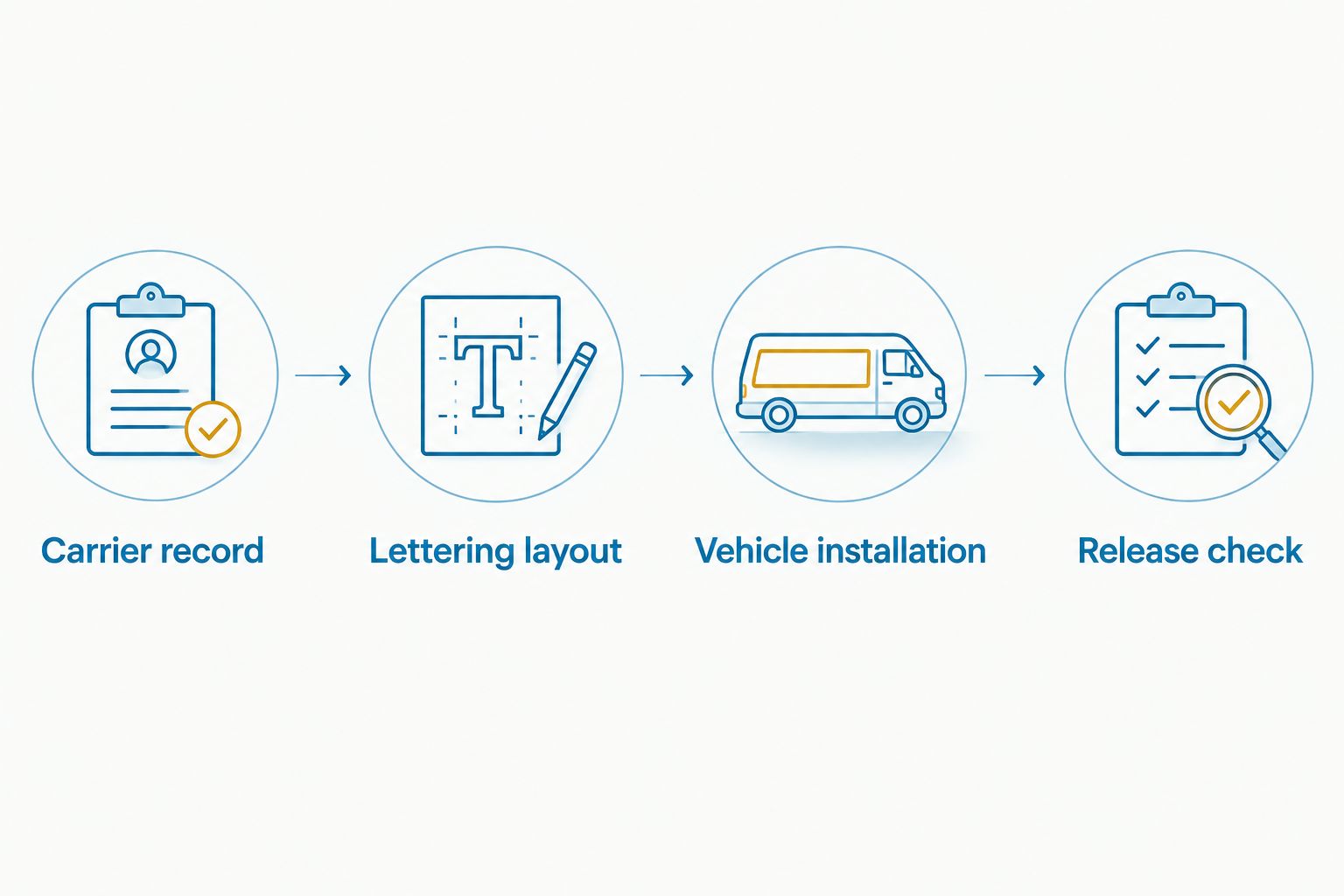
Instead of retyping carrier details for every truck, create one approved lettering record and use it to prepare, install, and check each decal. For 2026, the core federal USDOT number decal requirements are the carrier’s registered name and USDOT number on both sides of the self-propelled commercial vehicle, with contrasting markings readable from 50 feet while stationary in daylight.
A correctly typed number does not fix a missing carrier name, an unreadable font, or a marking hidden behind equipment. Treat the truck decal as an identification task first and a design task second.
The federal reference for this 2026 workflow is 49 CFR § 390.21, which governs markings on covered self-propelled commercial motor vehicles. Its general requirements include the operating motor carrier’s legal name or a single trade name listed on its Motor Carrier Identification Report, the assigned identification number preceded by USDOT, placement on both sides, contrast, and legibility. Special operating arrangements have additional provisions.
Nostalgifactory is best suited to consumers and small businesses seeking personalized vinyl decals, not regulatory certification. Keep that distinction clear: a decal maker handles the physical lettering; you approve the identity and check the finished vehicle. The DOT compliance decals guide for trucking and fleet companies provides related planning context.
Do not begin with a decorative layout and squeeze the required text into whatever space remains. Reserve a readable identification area first. That decision prevents a tidy-looking proof from becoming an unreadable truck.
Expected result: You have 1 approved master record containing the exact identity that belongs on the vehicle. The record controls the artwork, rather than the artwork becoming an unofficial source of carrier information.
For a 2026 fleet update, check the carrier record before reusing an earlier design. Reordering familiar lettering is convenient, but it repeats any spelling error or outdated identity just as faithfully as correct text.
Expected result: The proof matches the approved record and has a workable placement on 2 vehicle sides. You have checked the lettering at its intended size instead of relying on a zoomed-in preview.
The federal general marking rule uses a readability standard rather than a universal letter-height measurement. Approve the finished result, not a claimed minimum font size. Long names, thin strokes, tight spacing, and low contrast all deserve attention before production.
The workflow stays simple when you keep identity approval separate from layout approval: confirm the carrier, approve the proof, install the lettering, and inspect the finished truck.
The general federal rule permits removable markings when they meet its requirements. That does not make every removable display suitable for every truck. Choose the format around the surface and the carrier arrangement, then check the same identification and readability requirements.
| Marking format | Best for | Practical advantage | Limitation to address |
|---|---|---|---|
| Adhesive vinyl lettering | A vehicle that consistently operates for the same carrier | Keeps required identification attached to the chosen panel | Changes require removal and replacement; damaged paint needs assessment first |
| Removable marking display | An arrangement needing a changeable carrier display | Allows the displayed identification to change without replacing permanent lettering | Must remain secure, visible, and correct for the operation; attachment suitability depends on the vehicle |
Use adhesive vinyl lettering for a stable carrier assignment; use a removable display only with a clear changeover procedure. Neither format compensates for an incorrect name or unreadable text.
Nostalgifactory sells personalized vinyl decals and weatherproof stickers for business and vehicle uses. Personalization helps you specify wording, but weather resistance does not establish regulatory compliance. Confirm the intended surface and application instructions before choosing any decal for required truck markings.
Expected result: Both sides display the approved name and USDOT line without missing digits, distorted letters, or competing old identification. The installed lettering matches the proof, not just its general appearance.
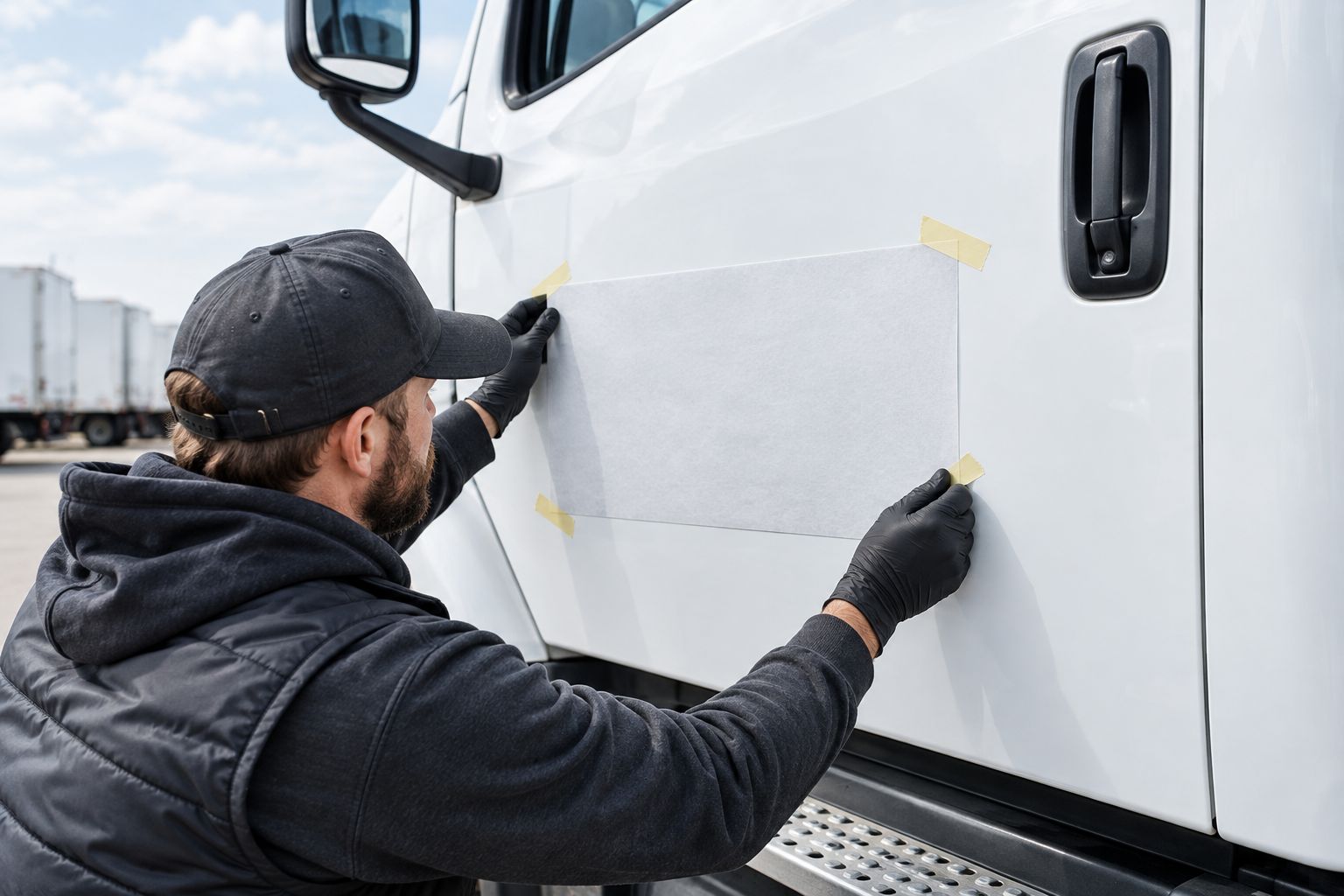
Positioning tape helps you check alignment before committing adhesive to the panel. Keep the required text clear of hardware instead of cutting a name or number apart to work around it.
Expected result: The 2026 release record identifies the vehicle, approved text, completed side checks, and person responsible for maintaining readable markings.
Do not release a truck with a correct proof but an incorrect installation. The vehicle is what must carry readable identification.
A second workflow starts when a truck changes operating carriers, the recorded carrier name changes, or a repair removes a marked panel. Treat the event as a new approval, not a routine copy-and-paste reorder.
A repaint also deserves a contrast check even when the carrier details stay the same. Lettering that was readable on the old finish is not automatically readable on the new one.
For leased or short-term rental arrangements, check the relevant provisions of 49 CFR § 390.21 before selecting a changeable display. Special provisions require more than simply swapping a number.
Add the required legal name or single trade name recorded with FMCSA. A logo-only design does not supply readable carrier identification unless it actually displays the required name and meets the marking requirements.
Rework size, stroke thickness, spacing, or contrast, then repeat the stationary daylight check. Do not solve a crowded layout by compressing the required text further; reduce optional decoration instead.
Inspect that side’s background, accessories, and panel geometry. Adjust its placement or layout rather than assuming identical decal dimensions guarantee identical readability.
Stop and check the supplied installation instructions, surface preparation, and panel condition. Replace damaged or distorted characters instead of stretching them back into shape and leaving ambiguous text.
Check the additional-name provisions in § 390.21. Where another name appears, the operating carrier’s required name must be preceded by Operated by; review the entire arrangement rather than adding unrelated branding first.
Keep compliance lettering separate from promotional artwork in your 2026 vehicle-design files. That separation lets you change a phone number, service description, or decorative graphic without accidentally editing the approved carrier identity.
For a small business, a shared folder with controlled artwork and a named approver is a practical starting point. Add each vehicle’s panel measurements and installation photos so the next order begins with verified details.
Nostalgifactory’s personalized vinyl decals suit business lettering and personal designs, but each design needs its own placement decision. Use the vehicle decal guide for contractors and home service businesses when planning promotional graphics around the reserved carrier-identification area.
What are the USDOT number decal requirements in 2026?
The general federal rule requires the operating carrier’s recorded legal name or single trade name and its assigned number preceded by USDOT on both sides of the self-propelled commercial vehicle. Markings must contrast with their background, remain legible, and be readable from 50 feet while stationary in daylight. Check applicability, special operating arrangements, and state requirements separately.
Does my USDOT decal need the company name too?
Yes, the general federal marking rule requires the operating carrier’s legal name or a single trade name listed on its Motor Carrier Identification Report. A USDOT number alone does not satisfy that name requirement.
Is there a federal minimum letter height for USDOT decals?
The general federal rule specifies readability from 50 feet, not a universal minimum letter height. Approve the actual lettering size, contrast, spacing, and placement against that standard rather than relying on a font-size claim.
Do USDOT markings have to be on both truck doors?
The general rule requires markings on both sides of the self-propelled commercial vehicle, not specifically on the doors. Choose side locations that keep the required text visible, contrasting, and readable.
Can I use removable USDOT markings instead of adhesive vinyl?
Yes, the general federal rule allows removable markings when they meet its requirements. Check secure attachment, correct carrier identity, readability, and any special provisions governing the operating arrangement.
Can Nostalgifactory certify that my truck decal is DOT compliant?
A personalized decal is not regulatory certification. Nostalgifactory sells personalized vinyl decals and weatherproof stickers; the carrier must verify the required identity, applicable rules, placement, and finished vehicle markings.
Do I need new lettering when a truck changes carriers?
Update the markings when the operating carrier’s required identity changes, subject to the applicable operating arrangement. Verify the new record, resolve obsolete identification, and repeat both-side readability checks before release.
The most useful final check starts farther away, not closer. A close photograph proves that letters exist; the stationary daylight check establishes whether someone can read them from the required distance.
Before closing your 2026 installation job, stand back and check both sides against the approved carrier record. Keep the attractive artwork, but let readable identification decide whether the truck is ready.