Custom vinyl decals for real estate agents: Plan first 2026


Real estate agents’ custom vinyl decals are personalized adhesive graphics with the aim of making an agent or brokerage recognizable and easy to contact. This 2026 guide explains how to plan vehicle and office decals while accounting for brokerage approval, property permissions, changing listings, and safe placement.
Your vehicle travels between appointments, while your office entrance identifies where clients should arrive. A decal gives either surface a defined communication job: identify your business, provide contact details, or direct someone to information.
Nostalgifactory custom vinyl decals are best for agents seeking personalized, handmade business graphics. Nostalgifactory sells personalized vinyl decals and weatherproof stickers, including business and vehicle designs. Match the individual material and application instructions to your intended surface rather than treating every decal as interchangeable.
Real estate work creates a particular planning problem: your identity stays relatively stable, but properties, showing arrangements, and listing status change. Put durable information on longer-term graphics and keep changing information somewhere you control.
For your 2026 decal plan, separate recognition from promotion. A vehicle graphic should not need replacing every time you take a listing, and an office door should not become a crowded property brochure.
Start with a written brief and a paper mock-up; neither requires design software. Follow the sequence below before buying a decal, then use the same brief when discussing a personalized design with a maker.
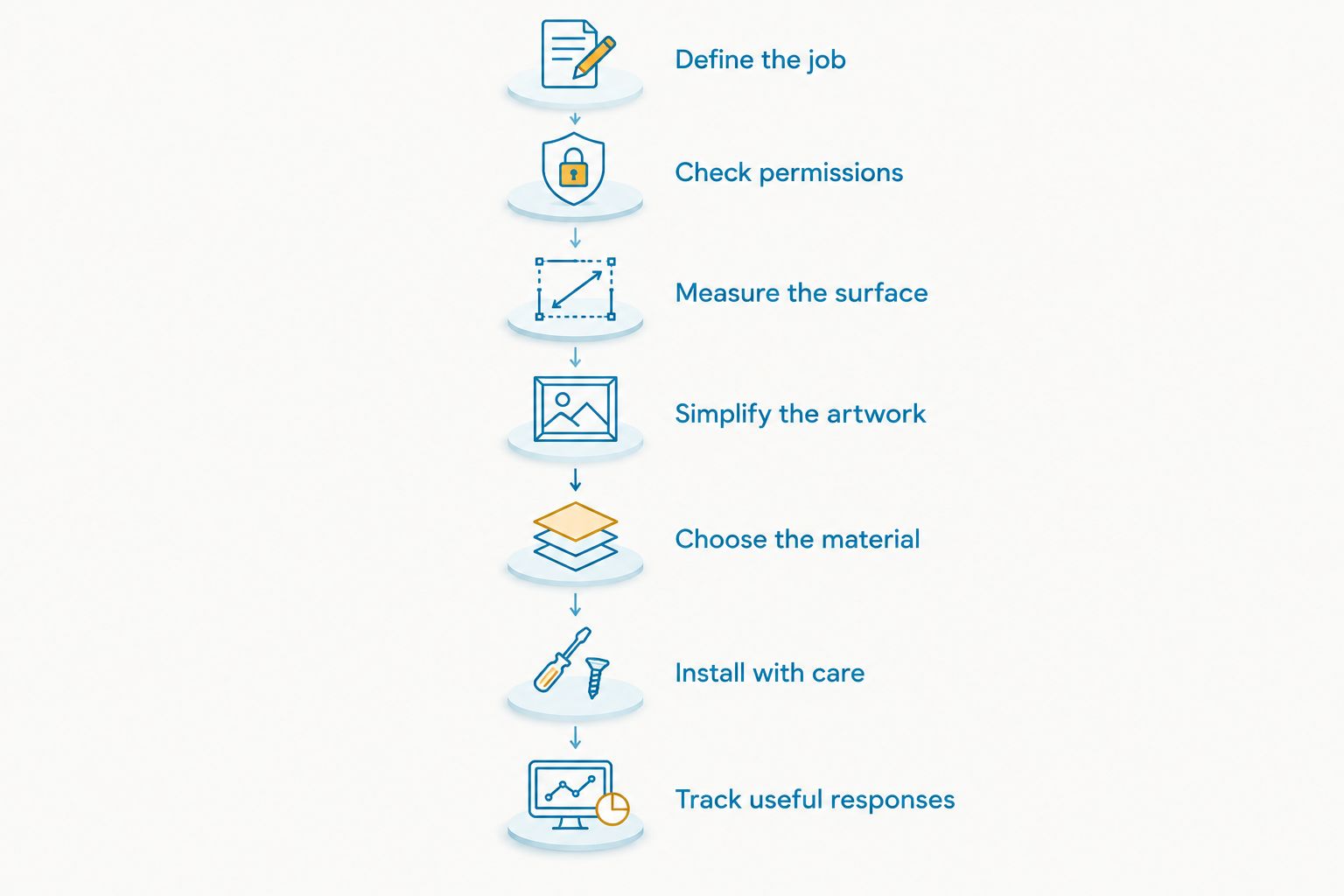
Write down what a person should understand or do after seeing the decal. Choose a primary purpose rather than asking a single graphic to introduce your business, advertise a property, explain your services, and collect inquiries.
For a vehicle, recognition and a readable contact method are useful priorities. For an office window, identifying the brokerage and entrance takes precedence. A QR code belongs where someone can stop safely and scan, not where you expect a moving driver to use it.
As a starting layout, use 3 text lines: business identity, agent identity where appropriate, and a contact method. Treat that as a design exercise, not an advertising compliance rule; required disclosures take priority.
Read your brokerage’s advertising requirements before creating artwork. Then ask the relevant owner or manager about the exact placement: your own vehicle, a leased vehicle, brokerage glazing, or a seller’s property each needs a separate decision.
Real estate advertising requirements vary by jurisdiction. Confirm the current requirements with your broker and state real estate regulator rather than copying another agent’s design. Brokerage identification, license disclosures, and use of professional designations need the same review as the rest of your advertising.
Make approval part of your 2026 order brief. A saved approval should identify the artwork and placement being authorized, not simply say that decals are acceptable.
Use a tape measure and make a full-size paper template. Position it on the intended surface with a suitable temporary attachment method, then examine it from where your audience will actually stand.
Record usable width and height in inches, excluding handles, trim, seals, and other obstructions. A large panel does not automatically offer a large practical installation area. Curves and moving parts make the layout more demanding.
Prepare 2 paper proofs: one for your proposed layout and one simplified alternative. The comparison helps you choose between more information and clearer information without buying either version first.
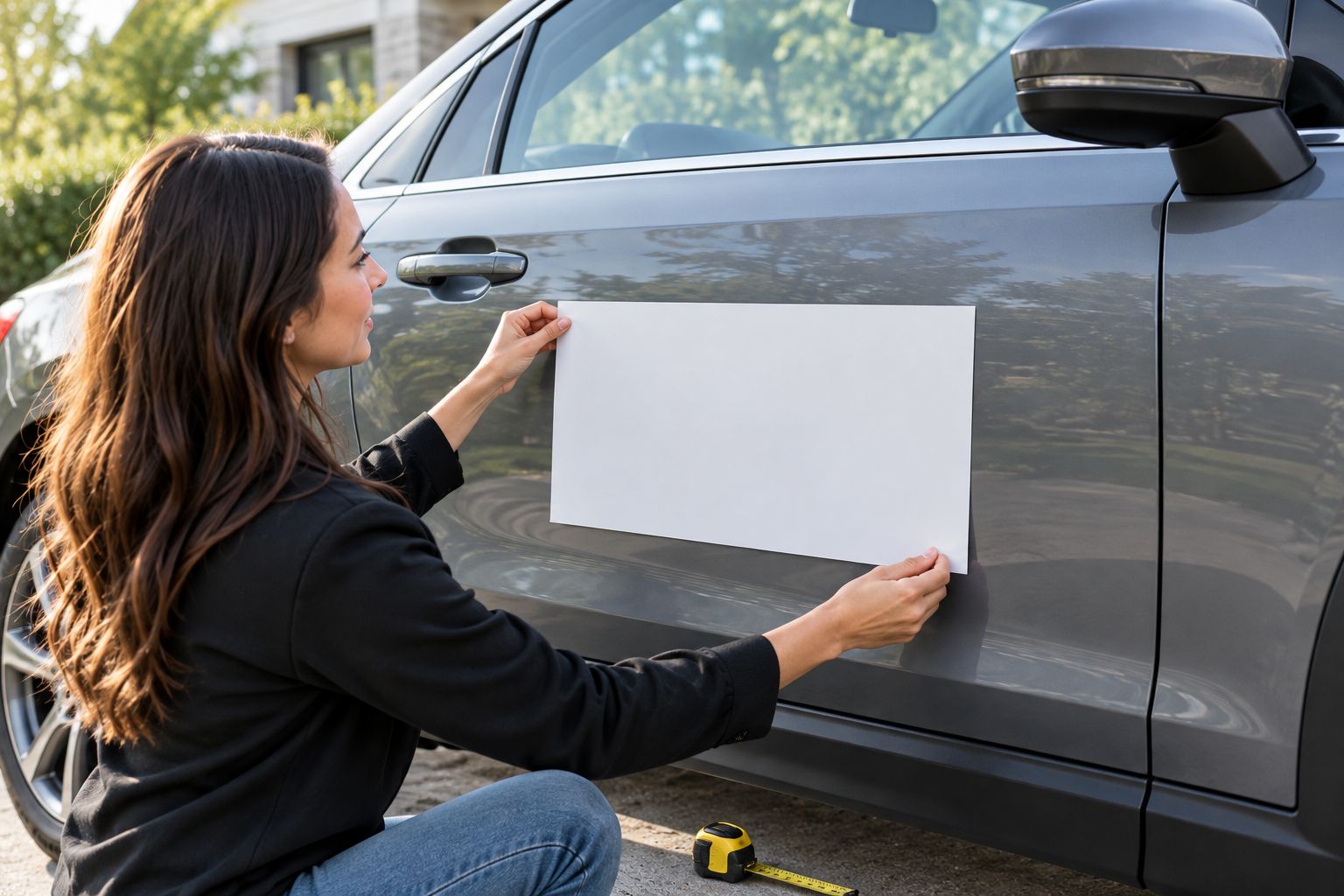
For vehicle-specific planning, the guide to custom business car decals provides a related starting point. Keep the actual vehicle’s surface and visibility requirements central to your decision.
Build the first draft with your approved logo, plain lettering, and the chosen contact method. A basic document or drawing application is enough to establish the hierarchy; decorative effects are not necessary at this stage.
Check the artwork at its actual installation size. Thin lettering, tightly spaced details, and elaborate scripts need particular attention because a design that looks attractive on a screen can be difficult to read on a car or window.
Nostalgifactory offers personalized, handmade decals. Bring the approved draft and measurements when discussing a business design, and confirm artwork requirements, text accuracy, and placement suitability before ordering; personalization alone does not establish those details.
For a 2026 campaign, avoid putting the year on lasting agent branding unless it serves a specific purpose. A dated promotion and an enduring business identity are different designs.
Decide how long the message needs to remain and what happens when it changes. Then ask about the specific decal’s adhesive, intended surfaces, outdoor suitability, and removal instructions. Weatherproof describes exposure suitability; it does not establish easy removal or compatibility with every surface.
Cut vinyl lettering suits a text-led layout without a printed background. Printed vinyl graphics suit designs that need imagery or a background panel. These are format choices, not promises about a particular maker’s materials.
For temporary property messages, consider a separate reusable sign instead of adhesive graphics on the property. For a vehicle used personally as well as professionally, compare a removable magnetic sign with adhesive lettering, subject to vehicle and sign compatibility.
Read the instructions for the specific decal before cleaning the surface or separating any layers. Installation methods differ between cut lettering, printed stickers, and other adhesive graphics; do not substitute a generic method for the supplied one.
Plan 1 test installation on a permitted, suitable surface before applying a larger set. If the decal is for a valuable finish, coated glass, or an unfamiliar surface, ask the material supplier and surface owner about compatibility first.
A professional installer is an option for large layouts or difficult placements. The benefit is installation help; the limitation is that installer involvement does not replace brokerage approval, surface permission, or material selection.
Start with a simple inquiry log. Ask new contacts how they found you and record answers consistently, separating vehicle recognition, office visits, referrals, and other sources.
A QR code can direct someone to a page you control, but scanning is not the same as making an inquiry. Record those actions separately. Do not report every page visit as a lead or claim the decal caused an inquiry without supporting information.
For your 2026 review, judge the decal against its original purpose. An office identification graphic and a lead-generation graphic need different measures; clear arrival instructions should not be judged only by sales inquiries.
Choose the format around the message, surface, and removal requirement. No single option handles permanent identification, frequently changing listings, and every vehicle equally well.
| Option | Best for | Practical advantage | Key limitation |
|---|---|---|---|
| Cut vinyl lettering | Text-led agent or brokerage identification | Presents lettering without a printed background panel | Fine details require careful artwork and application planning |
| Printed vinyl graphic | Designs needing imagery or a background | Keeps artwork together in a defined graphic area | Background and placement need checking against the surface |
| Removable-adhesive decal | Messages with a planned end date | Gives temporary use a defined material-selection priority | Removal suitability depends on the specific adhesive and surface |
| Magnetic vehicle sign | Agents wanting a detachable vehicle message | Can be removed between uses on a compatible vehicle panel | Needs a suitable magnetic surface and correct care |
| Separate reusable sign | Open houses and changing property messages | Keeps temporary information off the property’s finish | Requires storage, placement permission, and setup |
Choose lasting lettering for lasting identity and a separate format for changing property information. For any adhesive option, review the specific product rather than assuming the format guarantees durability or clean removal.
A decal on another vehicle does not establish that its wording meets your brokerage or jurisdiction’s requirements. Use your own approval process, including professional designation and logo permissions.
A listing agreement is not a substitute for explicit permission to apply an adhesive graphic. Discuss the location and removal plan with the owner; use a separate sign when property markings are unnecessary.
A property address, listing status, or open-house schedule gives the decal an expiration point. Keep those details on replaceable formats or a maintained destination, while your agent identity stays separate.
An elaborate logo and multiple contact routes compete for attention on a vehicle. Check a full-size proof on the actual surface and remove anything that makes the primary message harder to read.
A code should serve someone who can stand still safely, such as an office visitor or pedestrian beside a parked vehicle. Keep a readable contact method available instead of making scanning the only route.
What are the best custom vinyl decals for real estate agents?
The best custom vinyl decals for real estate agents match the approved message, intended surface, and removal plan. Use lasting identity details for longer-term graphics and a separate format for changing listing information.
Is cut vinyl lettering better than a printed decal for my real estate business?
Cut vinyl lettering is the better fit for a text-led design without a printed background; printed decals suit artwork needing imagery or a background panel. Check the actual material and surface requirements before choosing either format.
Can I put a real estate decal on my car window?
Confirm local visibility rules and the vehicle’s requirements before applying a window decal. Keep placement clear of required sightlines, wipers, seals, and moving parts, and confirm that the material suits the glass.
Should I put a QR code on my real estate vehicle decal?
Use a QR code only where a person can stop safely and scan it. Test the final-size artwork and destination, and keep a readable contact method available.
Can I use the same decal design on my office and vehicle?
Reuse the approved identity elements, but adapt the layout to each placement. Office visitors can approach and read, while vehicle graphics need a simpler message suited to the viewing situation.
Does weatherproof vinyl mean the decal will remove without damage?
Weatherproof vinyl does not establish damage-free removal. Confirm the specific adhesive, surface compatibility, and removal instructions before applying it to paint, glass, or a rented surface.
Does Nostalgifactory sell personalized business decals?
Nostalgifactory sells personalized, handmade vinyl decals and weatherproof stickers, including business designs. Confirm the artwork requirements and suitability of the individual decal for your intended placement before ordering.
Before approving your 2026 artwork, cover the decorative elements on the paper proof. Can someone still identify the business and find the contact method? If not, revise the hierarchy before ordering. The most useful decal is the one that communicates without asking the reader to study it.