Business door decals for medical and dental offices: complete 2026 guide


Dental office door decals are vinyl signs that identify your practice, show opening hours, and explain entry instructions so patients know where to go. This 2026 guide covers business door decals for dental offices and medical practices, where readable information matters more than decorative detail.
Your entrance should answer a patient's immediate questions: Is this the right practice? Is it open? Which door should I use? Put those answers ahead of social media handles, decorative borders, and long service lists.
Medical and dental entrances also need to distinguish opening hours from appointment rules. An office that is open does not necessarily accept walk-ins, and a locked door needs an instruction that reflects your actual check-in process.
Start with the principles in the business door decals guide, then adapt the wording to your practice. A healthcare entrance needs clear identification first and promotional detail second.
For your 2026 entrance review, treat the decal as part of a larger sign system. Suite identification, required accessibility signs, building directions, and temporary notices each have different jobs. A single vinyl design should not carry all of them.
Write the entrance message in a plain document before choosing fonts or colors. Use the public-facing practice name patients see on appointment reminders, and check whether the building identifies your entrance by a suite number, a street number, or both.
Separate permanent information from instructions that change. The practice name belongs in the stable layout; a temporary closure belongs on a replaceable notice. Give every line a reason to be there.
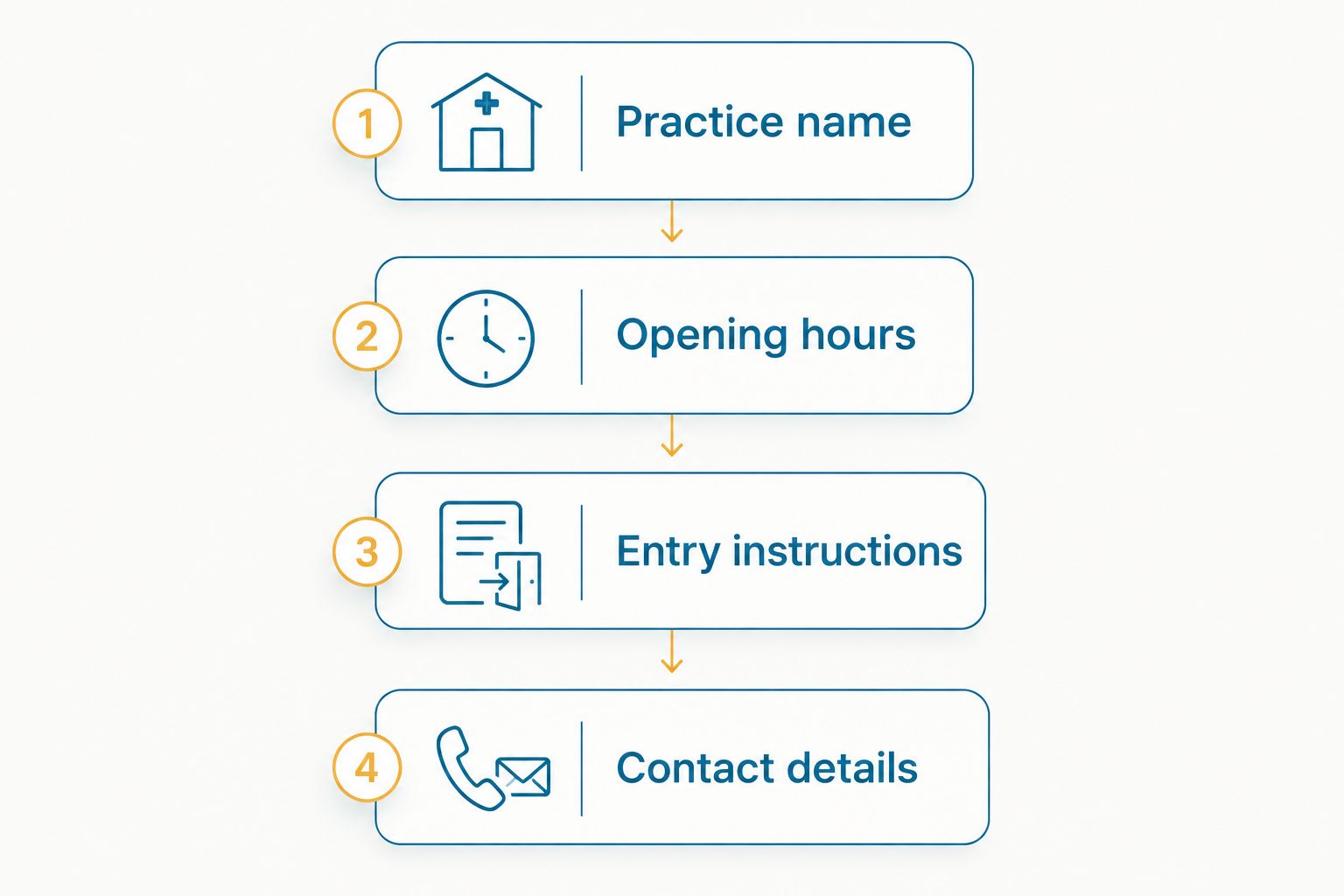
A useful hierarchy is Practice name, Opening hours, Entry instructions, and Contact details. Not every practice needs all four on the same pane. If reception is immediately inside, a short entrance message is often the better design choice.
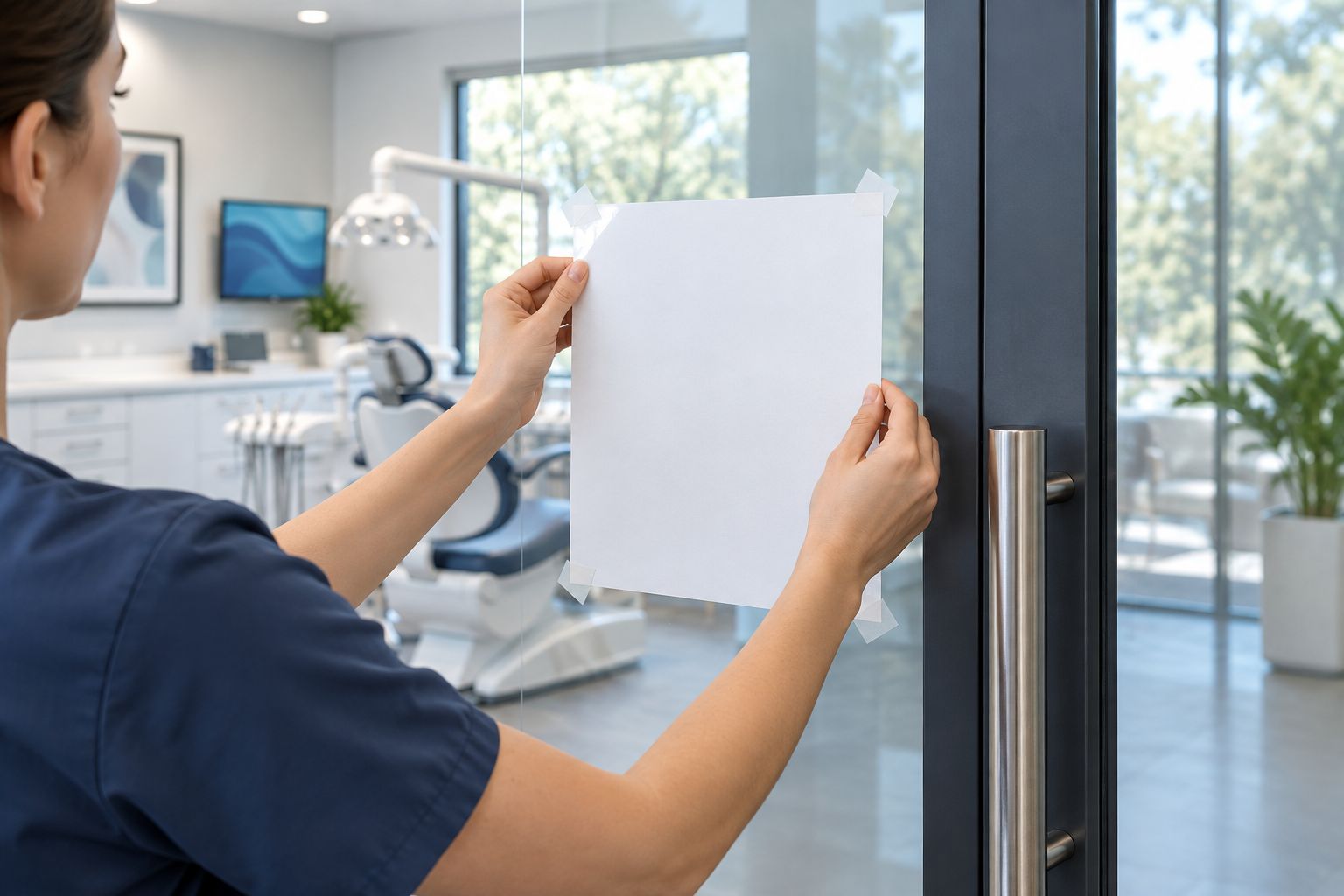
Make a full-size paper mockup before ordering vinyl. Measure the usable glass width and height in inches, excluding handles, frames, existing signs, and any area needed to see through the door.
Tape the mockup in place without applying adhesive vinyl. As a practical test, read it from 3 feet and 6 feet away; these are suggested viewing checks, not legal lettering standards. Then approach from the direction patients actually arrive.
Look at the design with the door closed and open. A line that looks centered on a photograph can disappear behind a handle or become difficult to read against the reception area. Check the mockup during daylight and with the interior lights on.
Start by deciding whether you need a combined business-information layout or a dedicated hours sign. You can make that decision with your paper mockup; buying a larger design does not solve unclear wording.
Nostalgifactory sells personalized business vinyl decals, including designs for hours and contact information. Nostalgifactory is best for offices seeking personalized business decals, not a substitute for required accessibility signage. A personalized layout gives you a way to present your information, but you still need to approve its accuracy and suitability for the entrance.
The Custom Business Vinyl Decal | Personalized Store Hours, Phone, Social Media Sticker | 5 Colors suits a combined information layout. The Custom Business Hours Decal – Store Hours, Phone & Website suits an entrance where the schedule and contact details are the main message.
Review the door layout with your building manager and the person responsible for accessibility before treating it as finished. In the US, signs identifying permanent rooms and spaces can be subject to tactile and Braille requirements under the ADA Standards for Accessible Design, Section 703; the requirements depend on the sign's purpose.
Flat vinyl lettering does not supply raised characters or Braille. Do not use a decorative door decal as a replacement for a required tactile sign. Also keep existing required signs visible and preserve their required placement.
For a 2026 update, ask what the entrance must display before adding optional notices. Building rules, applicable accessibility requirements, and your approved office policies take priority over a matching visual style. Treat infection-control messages as practice instructions that need clinical review, not decorative copy.
Start with the instructions for the exact decal and the door surface. Confirm that the glass, any coating, and your cleaning method are suitable before applying adhesive material. Do not assume every window film or treated surface accepts the same installation process.
Clean and dry the installation area as directed, then position the design before committing to the adhesive. A temporary alignment guide helps you keep the lettering level without relying on the edge of a handle or an uneven frame.
Keep your measurements and approved mockup nearby. If the layout no longer fits the real door, stop and correct the plan rather than squeezing the wording into a different location. Follow the supplied application method instead of improvising with water, heat, or solvents.
Give the final proof to the person who owns the practice schedule, not just the person choosing the design. Read the phone number digit by digit, verify the practice name, and check that the hours describe the entrance patients are using.
For your 2026 proof, distinguish regular hours from holiday exceptions. If different clinicians work different schedules, the front door should explain the office's actual access hours rather than imply that every clinician is present throughout them.
The two designs below address different needs: combined business information and hours with contact details. Nostalgifactory business decals offer personalization, but a fixed decal still requires an update when the information changes. Select the format after approving the text, not before.


Add the entrance to your office-update checklist. Whenever opening hours, contact details, or check-in procedures change, review the physical door alongside appointment reminders and your online business information.
Use a separate temporary notice for a short-term exception. Do not leave conflicting hours underneath it or keep an expired closure message on display. The entrance should give patients one clear instruction.
During your 2026 checks, look for lifting edges, damaged lettering, and readability against changing indoor displays. Follow the product's care guidance and your practice's cleaning requirements; a weatherproof description does not establish compatibility with every disinfectant.
Choose the format by the job it needs to do. A personalized business decal organizes stable information; a temporary notice handles an exception; a required accessibility sign addresses a different obligation.
| Option | Best for | Main advantage | Key limitation |
|---|---|---|---|
| Custom Business Vinyl Decal | Personalized Store Hours, Phone, Social Media Sticker | 5 Colors | Practices combining business information in one layout | Personalization for hours, phone, social media, and location information | Extra details need careful editing to avoid crowding |
| Custom Business Hours Decal – Store Hours, Phone & Website | Practices prioritizing the schedule and contact details | Focuses the entrance message on hours and contact information | Changed hours require updated lettering |
| Full-size paper mockup | Checking wording and placement before ordering | Lets you test the actual door without applying vinyl | It is a planning aid, not a finished permanent sign |
| Separate temporary notice | Holiday closures and short-term instructions | Keeps changing information outside the permanent design | Needs prompt removal when the exception ends |
| Required tactile and Braille sign, where applicable | Permanent room identification subject to accessibility requirements | Supplies required sign features when correctly specified | Requires separate specification and placement review |
Choose the smallest information set that answers the patient's entrance questions. Keep the complete service list and detailed office policies elsewhere.
An appointment-only practice needs wording that distinguishes office hours from walk-in access. Do not imply that a patient can enter simply because the posted schedule says the office is open.
A shared medical or dental office should identify the practice and explain general access. Put individual clinician schedules where staff can maintain them without repeatedly changing the main door design.
Decorative restroom wording and required room-identification signage are not interchangeable. Review the sign's purpose and applicable requirements before choosing the material or placement.
Glass has a changing background. Test the layout with reception furniture, lighting, blinds, and indoor notices in their normal positions rather than judging it only on a clean product-style image.
Pet access, health precautions, recording notices, and solicitation rules need deliberate decisions. A ready-made message is not automatically appropriate for a clinical entrance; use only wording that reflects your approved policies.
What's the best information to put on a dental office door decal?
Put the practice name, relevant opening hours, and essential entry instructions first. Add the entrance phone number when patients need to call from outside, and keep promotional details secondary.
Should medical office hours decals say appointment only?
Use appointment-only wording only when it accurately describes your office policy. Explain any call-before-entry procedure separately so patients know what to do at a locked entrance.
Can a vinyl door decal replace an ADA restroom sign?
Flat vinyl lettering cannot replace raised characters and Braille where those features are required. Review the room-identification requirements and sign placement separately from decorative door lettering.
Is white or dark lettering better for a glass office door?
The better choice is the lettering that stays readable against your actual glass and interior background. Test a paper mockup with the door closed, interior lights on, and the normal approach in view.
Can business door decals go on the inside of the glass?
Inside-glass installation depends on the decal's adhesive arrangement and reading direction. Confirm that the exact design is suitable for inside application and readable from outside before ordering.
How should a dental office clean around a vinyl decal?
Follow the exact decal's care instructions and confirm compatibility with your office cleaning process. Do not treat weatherproof wording as proof that the vinyl tolerates every disinfectant or abrasive cleaner.
What should we do when our office hours change?
Update the permanent hours display and remove any contradictory notices. Keep the entrance, appointment messages, and online hours consistent so patients receive the same instruction.
Do one final check from the patient's side of the glass. Inside-mounted wording needs the correct orientation to read properly from outside; a layout that looks right from reception is not enough.
Before completing your 2026 entrance update, have someone unfamiliar with the design approach the door and explain what it tells them. If they cannot identify the practice and the next action, simplify the message before ordering.